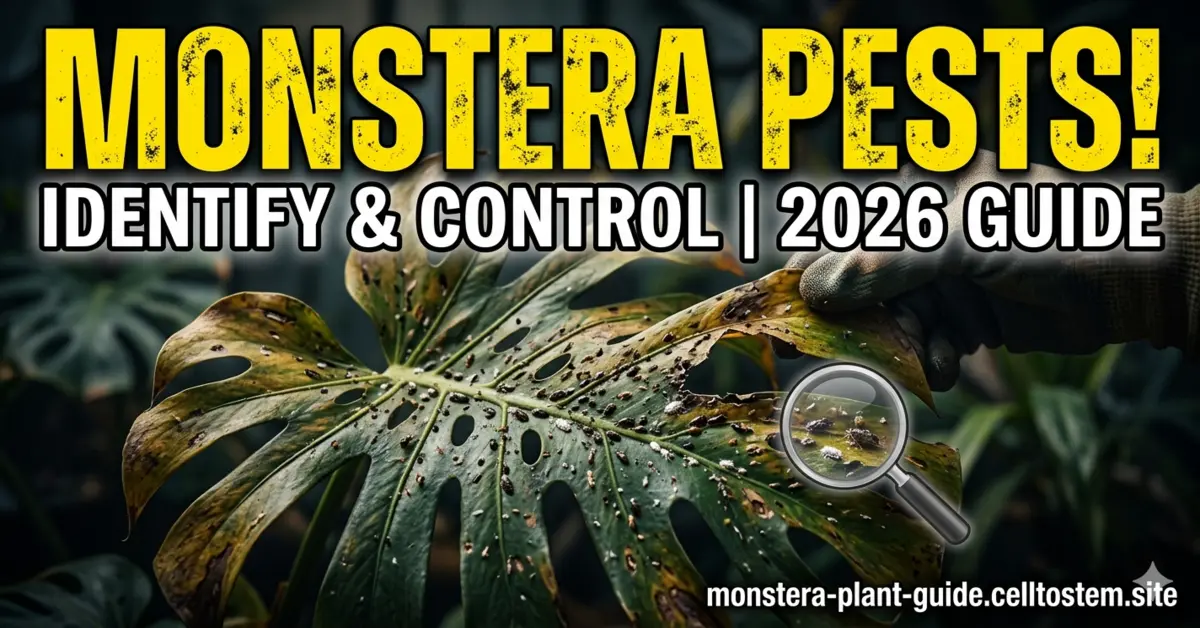
Quick Answer: How to Stop Monstera Pests
To identify and control Monstera pests, look for fine webbing (spider mites), cottony tufts (mealybugs), or sticky sap/brown bumps (scale). For an immediate fix, blast the plant with a strong stream of water to dislodge crawlers, then apply neem oil or insecticidal soap every 7 days. For persistent thrips or soil-borne fungus gnats, use systemic granules or beneficial nematodes to break the life cycle in the soil.
Table of Contents
My Battle with the “Swiss Cheese” Saboteurs
If you love your Monstera deliciosa, seeing a yellowing leaf feels like a personal heartbreak. I remember my first “Thai Constellation”—a pricey investment that suddenly developed monstera yellow leaves. I thought I was overwatering, but when I looked closer under a magnifying glass, the “dust” on the underside was actually moving. It was a full-blown spider mite invasion.
In this guide, I’m sharing everything I’ve learned from years of trial, error, and a few “houseplant funerals.” We’ll cover monstera plant pests identification and control using methods that actually work in 2026, from organic remedies to the heavy-duty stuff.
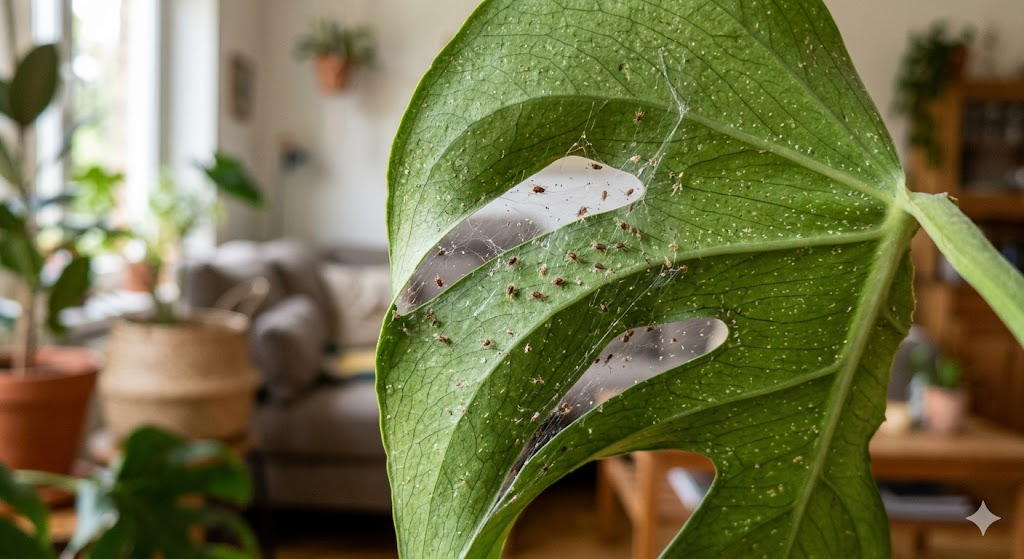
1. Spider Mites: The Invisible Web-Spinners
Spider mites thrive in dry, indoor air (especially in winter). They use piercing mouthparts to suck the life out of your plant, leaving behind tiny white dots called “stippling” (University of Connecticut, 2026).
- Identification: Look for fine webbing in the leaf “elbows” and monstera yellow leaves pests.
- The Fix: The best insecticide for monstera spider mites is often a two-pronged approach. First, give your plant a “shower” to physically knock them off. Then, apply a mixture of neem oil and castile soap.
- Pro Tip: I once tried to “mist” my way out of a mite problem. It didn’t work. Misting only raises humidity for minutes. Instead, use a dedicated humidifier to keep the air above 60%—mites hate moisture (Spider Farmer EU, 2025).
2. Thrips: The Tiny Black Daggers
Thrips are arguably the hardest pest to beat. These tiny black bugs actually lay eggs inside the leaf tissue, making surface sprays less effective.
- Identification: You’ll see silver-grey streaks or monstera brown spots pests. If you see a small, needle-like black bug crawling, it’s a thrip.
- The Control: The best spray for monstera thrips is a spinosad-based product like Captain Jack’s Deadbug Brew. In my experience, thrips laugh at weak organic sprays. If the infestation is “Level Red,” I use systemic granules containing imidacloprid (where legal) to kill them from the inside out (Reddit PlantClinic, 2026).
- Lesson Learned: I once “chopped” a monstera to the soil to get rid of thrips. It grew back, but the thrips were waiting in the soil. Always treat the soil, not just the leaves!
3. Mealybugs: The White Fuzzy “Cotton”
Mealybugs look like tiny bits of cotton wool stuck in the crevices of your plant. They excrete a sticky substance that leads to monstera sooty mold.
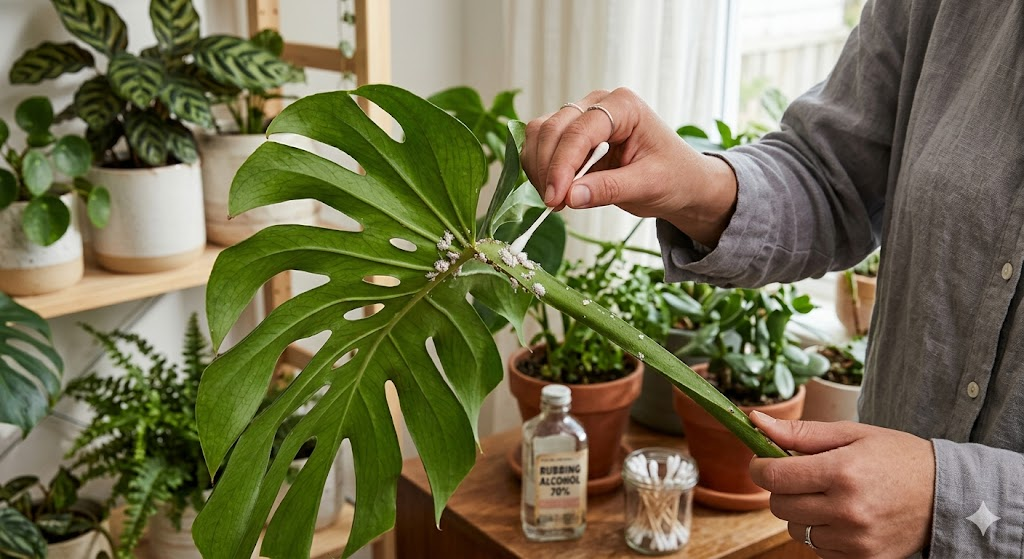
- Identification: Monstera white fuzzy bugs tucked into the leaf axils or under the leaves.
- The Fix: The best way to get rid of mealybugs on monstera is a Q-tip dipped in 70% rubbing alcohol. Touch each bug to dissolve their waxy coating. For a larger “army,” use an indoor plant bugs treatment like insecticidal soap.
- The Secret: Check the roots! Some mealybug species live underground. If your plant looks sick but the leaves are clean, it’s time to check the “basement.”
4. Scale Insects: The Hard Brown Bumps
Scale insects look like part of the plant—small, brown, raised bumps that don’t move. They are often the cause of monstera sticky leaves.
- Identification: Stationary brown bumps on stems. If you can scrape it off with a fingernail, it’s scale.
- The Control: The best product for monstera scale insects is horticultural oil (like Neem). It suffocates the “crawlers” before they can form a hard shell.
- Professional Advice: Do not use “leaf shine” products to clean the sticky residue. These products clog the plant’s pores (stomata) and can reduce gas exchange by 37% (LifeTips, 2026). Use a diluted castile soap wipe instead.
5. Fungus Gnats: The Soil-Dwellers
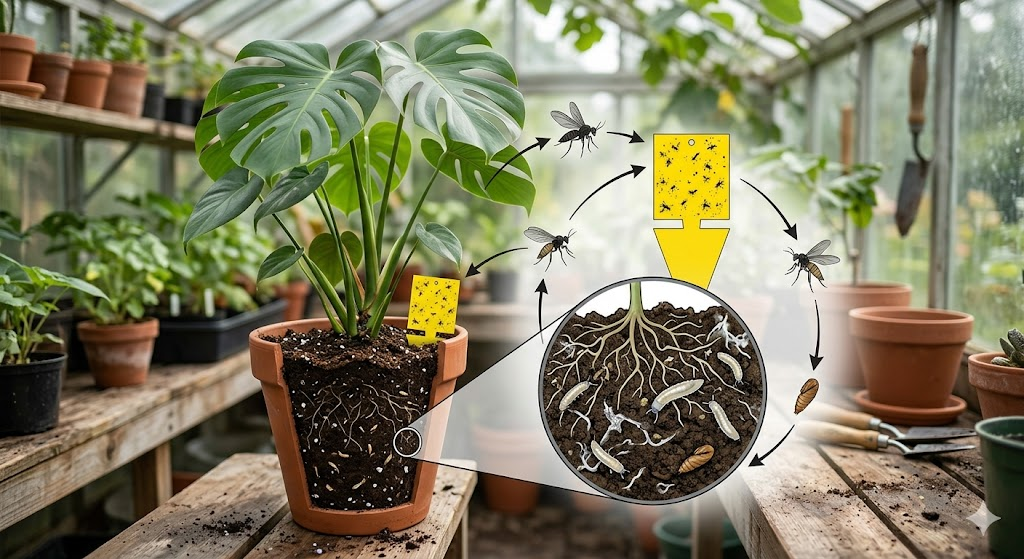
If you see little “fruit flies” dancing around your pot, you’ve got fungus gnats. They don’t usually kill the plant, but their larvae eat the roots.
- Identification: Flying gnats near the soil surface.
- The Fix: The best soil treatment for monstera gnats is “Mosquito Bits” (BTI bacteria) or beneficial nematodes. These organic hunters eat the gnat larvae in the soil.
- Prevention: Stop overwatering! Let the top two inches of soil dry out completely. I’ve found that bottom-watering is the best preventative for monstera pests that live in damp topsoil (HomePlantBot, 2026).
The Best Pest Control Strategies for 2026
Best Natural & Organic Remedies
If you prefer a chemical-free home, the best natural pest control for monstera involves biological warfare. I’ve had massive success releasing Amblyseius swirskii (predatory mites) onto my plants. They are tiny “lions” that hunt thrips and spider mites for you. This is the best organic remedy for monstera pests because it works 24/7 without you lifting a finger.
Best Commercial & Home Remedies
- Best commercial pesticide for monstera: Look for products containing Spinosad or Pyrethrin for fast knockdown of active bugs (PMC, 2020).
- Best home remedy for monstera bugs: A simple “Nuclear Mix” I use is 1 liter of water, 1 tsp of Dr. Bronner’s Peppermint Soap, and 1 tsp of Neem oil. The peppermint acts as a repellent while the soap dissolves the bugs’ skin.
Summary Table: Monstera Pest Identification
| Pest | Visual Sign | Sticky Leaves? | Best Treatment |
| Spider Mites | Webbing / White Dots | No | Shower + Neem Oil |
| Thrips | Silver Scars / Black Specs | No | Spinosad Spray |
| Mealybugs | White Fuzzy Tufts | Yes | Alcohol Q-tip |
| Scale | Brown Bumps | Yes | Horticultural Oil |
| Gnats | Flying “Flies” | No | BTI / Dry Soil |
My “Golden Rules” for a Pest-Free Monstera
- The 30-Day Quarantine: Never, ever put a new plant next to your collection immediately. I keep new arrivals in the bathroom for 4 weeks. This saved my entire collection when a “healthy” looking Pothos turned out to be a Thrip Trojan Horse.
- Clean the Leaves: Dust acts as a hiding spot for mites. Wiping leaves with a damp cloth every 2 weeks isn’t just for looks; it’s a scouting mission.
- Don’t Panic: Finding a bug isn’t a failure. It’s part of the hobby. Take a breath, isolate the plant, and start treatment.
FAQs
What are the tiny black bugs on my Monstera?
These are likely thrips. They are narrow, fast-moving, and leave silver or brown damage on the leaves. Use a systemic insecticide for the best results.
Why does my Monstera have sticky leaves?
Stickiness (honeydew) is a sign of sap-sucking pests like scale, mealybugs, or aphids. You need to treat the plant for insects, then wipe the leaves with soapy water to prevent monstera sooty mold.
Is Neem oil safe for Monstera?
Yes, but avoid applying it in direct sunlight, as it can “cook” the leaves. Also, avoid spraying new, unfurled leaves as they are more sensitive (Cornell University, 2026).
How do I get rid of brown spots from pests?
While you can’t “heal” a brown spot, you can prevent more by stopping the pests. Use the best spray for monstera thrips to halt the damage. You can prune heavily damaged leaves to help the plant focus energy on new growth.
References
- LifeTips. (2026). How to Clean Sticky Monstera Leaves Safely. Horticultural Physiology Review.
- University of Connecticut. (2026). Monstera deliciosa: Common Insect Pests. Home Garden Education Office. https://homegarden.cahnr.uconn.edu/factsheets/monstera-deliciosa/
- Spider Farmer EU. (2025). Proven Ways to Exterminate Spider Mites.
- PMC. (2020). Comparative Efficacy of Common Active Ingredients in Organic Insecticides. https://pmc.ncbi.nlm.nih.gov/articles/PMC7565045/
- HomePlantBot. (2026). Monstera Pests & Diseases Identification Guide.
Want to learn more about specific pest chemicals or local gardening supplies?
You can Search Google for Monstera Pest Control Products to find the best deals in your area!