Quick Answer:
Monstera deliciosa thrives in bright, indirect sunlight for 6 to 10 hours daily. While they can survive in lower light, they will grow slowly and lose their iconic leaf holes (fenestrations). For the best results, place your plant near an East or North-facing window, or use a full-spectrum LED grow light if your space is dim.
My Journey with the “Swiss Cheese” Obsession
I remember the first Monstera I ever bought. I tucked it into a cozy, dark corner of my bedroom, thinking it looked “aesthetic.” Within three months, that beautiful $50 plant looked like a sad, green stick. The new leaves were tiny, lacked any holes, and the stems were reaching desperately toward the door like they were trying to escape.
That was my first lesson in monstera plant light requirements: these plants aren’t just decor; they are solar-powered engines. Since that failure, I’ve grown dozens of deliciosas in everything from dim basement offices to sun-drenched sunrooms. I’ve burned leaves, salvaged cuttings, and experimented with every artificial bulb on the market.
This guide isn’t just a summary of what you’ll find on a plant tag. This is the “boots on the ground” reality of keeping a Monstera happy in a human home.
Understanding the “Bright, Indirect” Myth
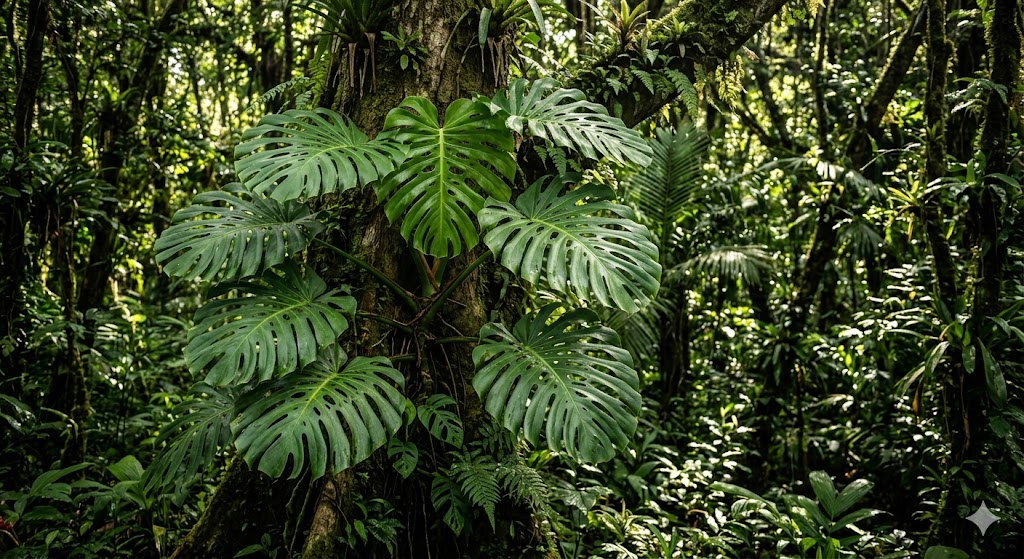
We see the phrase “bright, indirect light” everywhere, but what does it actually mean? In the wild, Monsteras are “hemiepiphytes.” They start on the dark forest floor and climb up trees toward the canopy. They want the sun, but they want the tree branches to filter it first.
The Best Window for Monstera Plant Success
If you are relying on natural sun, the best window for monstera plant growth is usually an East-facing window. It provides gentle morning sun that isn’t hot enough to scorch the leaves.
- South-facing: This is the “high stakes” window. It offers the best light intensity for monstera, but it can be too much. If your plant is right against the glass, the leaves will turn yellow or develop crispy brown patches—this is monstera light stress. I recommend pulling the plant 3-5 feet back or using a sheer curtain.
- North-facing: Often considered the best light for monstera in low light room scenarios. It’s consistent but weak. Your plant will live, but don’t expect those massive, holy leaves without help.
- West-facing: Great for afternoon glow, but watch out for the 4:00 PM “heat spike” which can dehydrate the soil too fast.
When the Sun Isn’t Enough: Artificial Solutions
I once worked in a corporate cubicle with zero windows. I was determined to have a “desk jungle,” which led me to research the best light for monstera in office settings.
Standard office fluorescent lights aren’t enough for monstera photosynthesis. They lack the red and blue wavelengths the plant needs to build tissue. To fix this, I turned to the best artificial light for monstera: full-spectrum LED panels.
Choosing a Grow Light
If you’re shopping, the best grow light for monstera deliciosa is one that offers a “daylight” spectrum (around 5000K-6500K). I found that a simple 36W LED grow bulb screwed into a regular floor lamp worked wonders.
When using artificial setups, the monstera light distance is critical. I’ve found that keeping a high-output LED about 12 to 24 inches above the highest leaf is the “sweet spot.” Any closer, and you risk bleaching the chlorophyll; any further, and the plant stops growing.
The Science of the “Stretch”
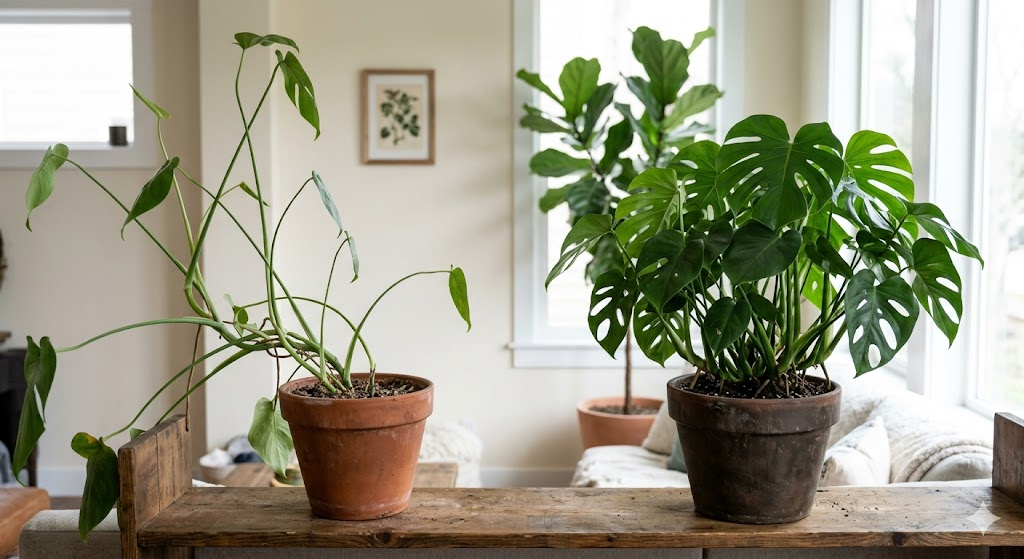
Have you noticed your Monstera getting “leggy”? This is called etiolation. When monstera light exposure is too low, the plant spends all its energy growing long, thin stems to “find” the sun.
In my experience, the monstera leaf color light connection is the easiest way to diagnose problems.
- Dark, Forest Green: The plant is likely getting just enough light but might grow slowly.
- Pale, Yellowish Green: Too much direct sun is “bleaching” the leaf.
- Black Spots: This is often a combination of low light and overwatering (the plant can’t process the water without light).
The Best Light Schedule for Monstera
Consistency is better than intensity. I follow a monstera light duration of 10 to 12 hours of “on” time when using lights. In the winter, I increase this to 14 hours to compensate for the gloomy weather. Plants need a “dark period” too—don’t leave your lights on 24/7, or you’ll exhaust the plant’s metabolic rhythm.
Propagation and Cuttings: Light for the Little Ones
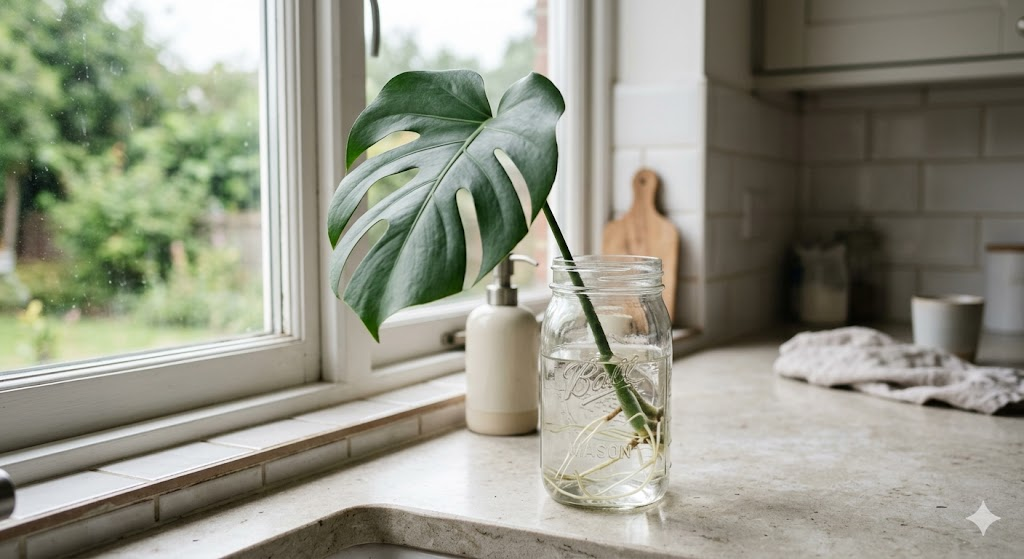
When you take a cutting, the rules change slightly. The best light for monstera cuttings is bright but strictly indirect. Because a cutting has no roots, it can’t take up water to replace what it loses through evaporation in high heat.
I’ve had the best luck placing my water-propagation jars on a kitchen counter near a North window. This provides enough energy for monstera photosynthesis to trigger root growth without the stress of direct thermal heat.
Troubleshooting Like a Pro
After years of trial and error, I’ve developed a “light-first” diagnostic check. Before you add fertilizer or more water, ask:
- Is it leaning? Rotate the pot 90 degrees every week. If it’s leaning heavily, it needs more overhead light.
- Are the new leaves solid? If your 3-year-old plant is putting out leaves without holes, it is starving for light. Move it closer to the window immediately.
- Is the soil staying wet for weeks? This is a hidden light issue. Light drives the “pump” that pulls water out of the soil. Low light = soggy soil = root rot.
Real-World Case Study: The Basement Success
I have a friend who lives in a basement apartment with only “window wells.” We set up a dedicated corner with the best artificial light for monstera we could find—a high-end COB (Chip on Board) LED.
We set the monstera light spectrum to favor the “blue” end during the first six months to encourage tight, bushy growth, then switched to a warmer “red” spectrum to encourage larger leaf size. Within a year, her “basement beast” had leaves 20 inches wide. It proves that with the right tech, you can ignore the blueprints of your house.
Final Thoughts from the Greenhouse
Owning a Monstera is a conversation between you and the sun. Some days the sun is too loud, and you need to pull the curtains. Some days it’s too quiet, and you need to flip on a switch. By mastering monstera plant light requirements, you aren’t just keeping a plant alive—you’re sculpting a living piece of the jungle.
If you are ever in doubt, remember: If you can’t comfortably read a book in that spot without a lamp, your Monstera can’t grow there.
Frequently Asked Questions (FAQs)
Q: Can a Monstera live in a windowless bathroom?
A: Only if you leave the light on! Standard bathroom lights aren’t enough. You would need a specialized LED grow bulb to keep it healthy.
Q: Why are my Monstera leaves turning brown and crispy?
A: This is usually monstera light stress from too much direct sun. Move the plant back from the window or add a sheer curtain.
Q: How do I get more “holes” in my leaves?
A: Increase the monstera light exposure. Fenestrations are the plant’s way of letting light reach lower leaves. If it has plenty of light, it will produce more holes.
Q: Is a warm or cool light better for Monsteras?
A: A “Full Spectrum” or “Daylight” (5000K) bulb is best. It mimics the natural sun most accurately.
Q: How many hours of light does a Monstera need?
A: Aim for 8-12 hours of bright, filtered light for optimal growth.
Helpful Resources
For more information on identifying your specific plant species or finding local nurseries, you can search more on the Google Search Engine.
To learn more about advanced indoor gardening technology, feel free to Search Google for the latest 2026 reviews.